







Beaufort National Cemetery
NCA marks 50 years (1973-2023) of serving America's Veterans, Service Members, and Families.
Learn more and watch NCA's 50th Anniversary Ceremony.
Visitation Hours: Open daily from 8:00 a.m. to sunset.
Office Hours: Monday thru Friday 8:00 a.m. to 4:30 p.m. Closed federal holidays except Memorial Day and Veterans Day.
This cemetery has space available to accommodate casketed and cremated remains.
Burial in a national cemetery is open to all members of the armed forces who have met a minimum active duty service requirement and were discharged under conditions other than dishonorable.
A Veteran's spouse, widow or widower, minor dependent children, and under certain conditions, unmarried adult children with disabilities may also be eligible for burial. Eligible spouses and children may be buried even if they predecease the Veteran.
Members of the reserve components of the armed forces who die while on active duty or who die while on training duty, or were eligible for retired pay, may also be eligible for burial.
The cemetery is located within the Beaufort city limits, 42 miles north of the Savannah (GA) International Airport. From Savannah, take U.S. Interstate 95 North, then State Hwy 278 East, exit on State Hwy 170 North to U.S Highway 21 South. Cemetery is approximately one mile on the left on U.S. Highway 21 South, which is also Boundary Street.
Fax all discharge documentation to the National Cemetery Scheduling Office at 1-866-900-6417 and follow-up with a phone call to 1-800-535-1117.
For information on scheduled burials in our national cemeteries, please go to the Daily Burial Schedule.
Military Funeral Honors
A heavily populated military community surrounds the cemetery; therefore, families of veterans can obtain Military Funeral Honors with little difficulty. Military Funeral Honors are provided by Charleston Air Force Base, Charleston, SC; Fort Stewart Army Base, Savannah, GA; Marine Corps Recruit Depot, Parris Island, SC; Marine Corps Air Station, Beaufort, SC; and Beaufort Naval Hospital, Beaufort, SC.
For educational materials and additional information on this cemetery, please visit the Education section, located below.
Our cemetery floral regulations exist only to reflect the honor and respect we hold for our Nation's Veterans, by preserving the dignity and solemnity of their final resting place.
We welcome fresh-cut flowers throughout the year using cemetery-supplied floral vases. The vases are in bins throughout the cemetery.
Items left at the gravesite must be floral in nature (except as noted) and may not stand taller than the headstone. One small American or service flag may also be placed on the gravesite. Flags will be removed and properly disposed of if they are damaged, faded, tattered or otherwise unserviceable.
Floral arrangements may be placed at the bottom of the niche column at the columbaria. To ensure space for other visitors, please limit floral arrangements to one per niche.
Flowers will be removed when they become unsightly, for mowing and maintenance, or if damaged by weather or wildlife. Due to the open nature of the grounds, we cannot guarantee against theft, vandalism or the effects of nature.
Unauthorized items are not permitted on the gravesites or niche covers. Please remember, items listed below detract from the dignity of the Beaufort National Cemetery and may create a safety hazard for you, your family, visitors and staff. Unauthorized items will be removed immediately. Examples of unauthorized items include;
- Installation of permanent floral vases or plantings
- Potted plants
- Flowers in glass or metal vases
- Statues
- Balloons
- Vigil lights
- Breakable objects
- Hazardous materials
- Glass
- Metal
- Toys
- Stuffed animals
- Candles
- Food items
- Flags other than the American flag or service flags, and similar items.
Department of Veterans Affairs does not permit:
- Items which are considered offensive, inconsistent with the dignity of the cemetery.
- Adornments considered hazardous to visitors and cemetery personnel. For example, items incorporating beads or wires may present a tripping hazard or become entangled in mowers or other equipment and cause injury.
December 15 through January 10 - artificial flowers, wreaths (less than 18 inches in diameter) and gravesite blankets (less than 2 x 3 feet) are permitted.
Flags for Memorial Day may be placed on gravesites up to 5-days before the holiday. The cemetery staff will remove items 5-days after the holiday.
To preserve the dignity and honor of our Veterans' final resting place, please observe the following rules of behavior while visiting the cemetery grounds:
- No altering a headstone or niche cover in any manner. Examples include marking on, adhering photographs or keepsakes to, sitting on, placing objects upon, etc.)
- No pets are allowed on the cemetery grounds at any time.
- No smoking on the grounds, in any building or the committal shelter.
- No soliciting.
- No picnicking.
- No boisterous activity of any kind. This includes but is not limited; playing loud music or yelling.
- No sports or recreational activities of any kind.
- No public gatherings of a partisan nature.
- No unauthorized gatherings.
- No loitering. Committal shelters are for services only.
- No littering, please use one of the many receptacles provided.
- No cutting, digging or otherwise damaging the landscape.
- These rules are covered by the U.S. Code of Federal Regulations (38--1.218) and are subject to fines.
We thank you in advance for providing the respect our Veterans are due, by observing the above listed rules. Our Nation's Heroes, some of whom gave their lives for this country, deserve no less than an honorable and pristine landscape to make their final rest.
VA regulations 38 CFR 1.218 prohibit the carrying of firearms (either openly or concealed), explosives or other dangerous or deadly weapons while on VA property, except for official purposes, such as military funeral honors.
Possession of firearms on any property under the charge and control of VA is prohibited. Offenders may be subject to a fine, removal from the premises, or arrest.
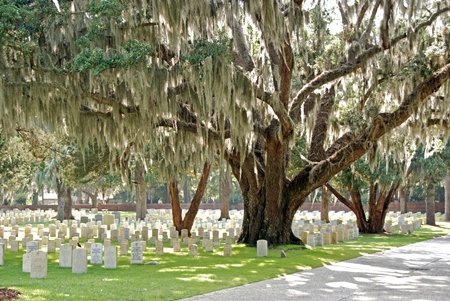
Beaufort National Cemetery is located in Beaufort County on Port Royal Island within the city limits of Beaufort, South Carolina.The cemetery best distinguished by a landscape plan in which the burial sections are arranged in the shape of a half-circle with roads arranged like the spokes of a wheel.
Although local Native Americans had inhabited the region for thousands of years, it was not until 1514 that Beaufort County became the site of the second landing of Europeans on the North American continent. After an extended period of settlement, in 1587 the Spanish withdrew from the region in the wake of attacks by the English in Florida. For approximately eight decades the land was left to its original inhabitants. Eventually, King Charles II granted the territory to a group of eight proprietors who named it "Carolina" after their benefactor. The first settlers included many Barbadians, and Carolina came to more closely resemble the plantation economy of the West Indies than the other mainland colonies. In 1711, a year after the territory was divided into South Carolina and North Carolina, the town of Beaufort was founded.
Prior to the Civil War, Beaufort was a center of culture and affluence in the American South. Immense fortunes were made through the cultivation of rice, indigo, and later, long-staple sea cotton. Wealthy plantation owners had summer homes in Beaufort where they could benefit from cool breezes coming off the Beaufort River. The town was also a hotbed of secessionist sentiment. In 1860, the first meeting to draft the Ordinance of Secession (by which South Carolina led the withdrawal of the southern states from the Union), was held in Beaufort. As a result, the city was an early target of Federal forces.
South Carolina formally seceded from the Union on December 20, 1860. One month later, a Union fleet circled Port Royal Sound and within less than a year after secession Union forces occupied the city, and held it for the balance of the war. The Confederate Fort Walker was renamed Fort Welles, becoming the center of a large garrison that at one point had as many as 50,000 occupants. Fort Welles served as the headquarters of the Department of the South and the refueling and supply depot for the South Atlantic Blockading Squadron. General William Tecumseh Sherman's march through the state at war's end left a trail of destruction that brushed Beaufort County. The war, while not physically decimating the area, claimed one-fifth of the white male population of the state and shattered its economy.
The original interments in the cemetery were men who died in the nearby Union hospitals during the occupation and were initially buried in several places — among them East Florida and Hilton Head. About 2,800 remains were removed from cemeteries in Millen and Lawton, Georgia, and reinterred in the national cemetery; 117 Confederate soldiers are also interred here.
In May 1987, souvenir hunters using metal detectors on Folly's Island near Charleston discovered the remains of 19 Union soldiers. The South Carolina Institute of Archaeology and Anthropology identified the remains as members of the 55th Regiment and the 1st North Carolina Infantry. Both units were composed of black troops who fought side by side with the 54th Massachusetts Regiment. The 1989 Memorial Day program at Beaufort National Cemetery featured the reinterment of the 19 Union soldiers missing in action since 1863. The Honor Guard for the service was composed of actors from the cast of the movie "Glory," which was being filmed nearby.
Beaufort National Cemetery was listed on the National Register of Historic Places in 1997.
Monuments and Memorials
The 1870s Union Soldiers monument was erected in honor of 174 unknown Union dead buried at the cemetery; it is marble set on a brick base.
A large granite monument dedicated to "the Defenders of American Liberty Against the Great Rebellion" was erected during the 1880s.
Blue Star Memorial was installed in 1998. Sponsored by the Beaufort Garden Club in cooperation with the Garden Club of South Carolina, the marker is a tribute to American men and women who have served, are serving, or will served their county. Its symbolism is linked to World War II, when families of service members displayed in a home window a square flag decorated with a blue star to signify that a loved was in the armed forces.
The "Fighting Fourth" Marine Monument was erected and dedicated in 1995 by the Fourth Marine Division Assn, Carolina Chapter No. 26.
In 1997, a memorial in honor of Confederate soldiers interred at the cemetery was installed.
Medal of Honor Recipients
The Medal of Honor is the highest award for valor in action against an enemy force that can be bestowed upon an individual serving in the Armed Services of the United States. Recipients receive the Medal of Honor from the president on behalf of Congress. It was first awarded during the Civil War and eligibility criteria for the Medal of Honor have changed over time.
Recipients buried or memorialized here:
Private First Class Ralph H. Johnson (Vietnam). Ralph Johnson was born in Charleston, South Carolina, on January 11, 1949. He enlisted in the U.S. Marine Corps Reserves in March 1967, and thereafter, the regular USMC, to fight in the Vietnam War. On March 5, 1968, PFC Johnson and his patrol, overlooking the Quan Duc Valley, were attacked by enemy forces. Johnson threw himself on a grenade and warned his comrades; actions that prevented the enemy from advancing and saved the life of a fellow marine. PFC Johnson received the Medal of Honor posthumously. The Charleston VA Medical Center was renamed for him in September 1991, and the navy named a destroyer (U.S.S. Ralph Johnson DDG 114) after him in 2015. Johnson's remains were interred in Beaufort National Cemetery in March 1970, in Section 3, Site 21.
Captain John James McGinty III (Vietnam). McGinty was born in Boston in 1940, and he enlisted in the U.S. Marine Corps after graduating from high school. In 1966, McGinty began a tour of duty in Vietnam. On July 18, attacked by the North Vietnamese and severely wounded in the left eye, he saved the lives of dozens of men. McGinty received the Medal of Honor from President Lyndon B. Johnson in 1968. Later, as a born-again Christian, a faith that rejects idolatry, he chose to not display the medal because it features the image of Minerva. Captain McGinty retired in 1976 and worked at the VA Medical Center in San Diego, California. He died January 17, 2014, and is buried in Section D, Site 703.
Other Burials
Colonel Donald Conroy, "The Great Santini" is interred in Section 62, Grave 182.
Charles "Chuck" Taliano was born in Ohio in 1945 and served in the U.S. Marines from 1964 to 1968. Sergeant Taliano trained at Parris Island, SC, and was posted there as a drill Instructor in 1966. Photographed while addressing a recruit shortly before his tour ended, he became the face of the service during the Vietnam Era. The picture of Taliano, captioned "We don't promise you a rose garden," appeared on recruiting posters into the 1990s. After a civilian career in publishing, Taliano retired to Beaufort and ran a gift shop on Parris Island where he received thousands of visitors every year. Many men said they joined the marines because of Taliano. He died June 4, 2010, and is buried in Beaufort National Cemetery (Section A, Grave 120).
Nineteen Union Soldiers of the all black Massachusetts 54th and 55th Infantry were removed from Folly Island, S.C., and reinterred here with full military honors on Memorial Day, May 29, 1989.
South Carolinian Joseph Simmons was born in 1899. He attended the Penn School on St. Helena Island, one of the country's first schools for freed slaves, and enlisted in the army on February 18, 1918. MSgt. Simmons fought with the French during World War I, attached to the 5th Marines in three campaigns, including Belleau Wood. During World War II, Simmons served with the 25th Infantry, Buffalo Soldiers. An interest in music led to his becoming assistant bandleader, 92nd Division, in 1944. Simmons served for 34 years in all. For his World War I service, he received the French Legion of Honor Medal just a few weeks before his 100th birthday. He died September 24, 1999 (Section 2, Grave 2).
Gerd Reussel, German World War II Prisoner of War, Section PB61, Grave 18.
On February 11, 1962, eight U.S. servicemen and two South Vietnamese air force personnel died when their C47 transport plane was shot down between Saigon and Danang. The mission was to drop propaganda leaflets with lunar new year wishes to Vietnamese people. Among the dead were six members of the U.S. Air Force — the first USAF casualties of the Vietnam conflict. The remains of USAF Technical Sergeant Floyd M. Frazier (b. 1927) and Army Specialist 4th Class Glen F. Merrihew (b.1940) were comingled because of the crash, and Beaufort National Cemetery was selected by the military for their burial between the decedents' next of kin. Frazier, the youngest of twelve, was survived by his wife Doris and three children. Merrihew, just 21 years old, was due for discharge in September; sister Leona was his legal guardian. Funeral services were held March 12, 1962 (Section 42, Gravesite 234).
More than half of VA's national cemeteries originated with the Civil War and many are closed to some burials. Other sites were established to serve World War veterans and they continue to expand. Historic themes related with NCA's cemeteries and soldiers' lots vary, but visitors should understand "Why is it here?" NCA began by installing interpretive signs, or waysides, at more than 100 properties to observe the Civil War Sesquicentennial (2011–2015). Please follow the links below to see the interpretive signs for Beaufort National Cemetery.
View Videos and Educational Lesson Plans about this cemetery, or visit the Veterans Legacy Program and NCA History Program for additional information. Thank you for your interest.


