







National Cemetery Administration
Forest Hill Cemetery Soldiers' Lot
NCA marks 50 years (1973-2023) of serving America's Veterans, Service Members, and Families.
Learn more and watch NCA's 50th Anniversary Ceremony.
Visitation Hours: Open daily from sunrise to sunset.
Office Hours: Monday thru Friday 8:00 a.m. to 4:30 p.m.
Closed federal holidays except Memorial Day.
This soldiers' lot is closed to interments.
Burial in a national cemetery is open to all members of the armed forces who have met a minimum active duty service requirement and were discharged under conditions other than dishonorable.
A Veteran's spouse, widow or widower, minor dependent children, and under certain conditions, unmarried adult children with disabilities may also be eligible for burial. Eligible spouses and children may be buried even if they predecease the Veteran.
Members of the reserve components of the armed forces who die while on active duty or who die while on training duty, or were eligible for retired pay, may also be eligible for burial.
From Milwaukee: Take Interstate 94 to Madison, Wisconsin to the Interstate 90 South exit, then take exit 142A. Take SR-12 and 18 West. Follow SR-12 and 18 West to the Dodgeville Exit (Midvale Boulevard). Turn right on Midvale Boulevard and go to Mineral Point Road, which will be the 4th stoplight. Turn right on Mineral Point Road. Mineral Point Road curves to the left and becomes Speedway Road. Follow Speedway Road for approximately two blocks and the cemetery will be on the right. Forest Hill Soldiers Lot number designator is section 35.
From Dane County Regional Airport (7.6 miles from the cemetery): Turn left on airport exit; then turn left on International Lane. Bear left onto Packers Avenue. Continue on Pennsylvania Avenue to East Johnson. Turn onto East Johnson and travel to East Gorham Street. Turn onto East Gorham Street and follow to West Gorham Street. From West Gorham Street turn onto University Avenue; then turn left onto North Park Street. Turn right onto Regent Street and travel to 1 Speedway Road and the cemetery will be on your right. Forest Hill Soldiers Lot number designator is section 35.
From the North: Take US-151 South exit towards Washington Avenue/State Capitol. Turn left on South Blair Street then turn right on John Nolen Drive. Turn right on North Shore Drive, which will become Proudfitt Street. Continue on Regent Street and you will arrive at the cemetery and the soldier's lot is to the left. Forest Hill Soldiers Lot number designator is section 35.
From the South: Take US-12 West/US-18 West. Take the John Nolen Drive exit; exit #263 then turn left on North Shore Drive. North Shore Drive becomes Proudfitt Street. Continue to Regent Street and you will arrive at the cemetery and the soldier's lot is to the left. Forest Hill Soldiers Lot number designator is section 35.
From the East: Take US-151 South exit towards Washington Avenue/State Capitol. Turn left on South Blair Street then bear right on John Nolen Drive. Turn right on North Shore Drive, which will become Proudfitt Street. Continue on Regent Street and you will arrive at the cemetery and the soldier's lot is to the left. Forest Hill Soldiers Lot number designator is section 35.
From the West: Take US-18 East/US-151 North. Continue on Verona Road. Turn on South Midvale Boulevard. Turn right on Mineral Point Road continue on Speedway Road. Turn right onto Regent Street and you will arrive at the cemetery and the soldier's lot is to the left. Forest Hill Soldiers Lot number designator is section 35.
Fax all discharge documentation to the National Cemetery Scheduling Office at 1-866-900-6417 and follow-up with a phone call to 1-800-535-1117.
For information on scheduled burials in our national cemeteries, please go to the Daily Burial Schedule.
The private and community cemeteries that contain NCA soldiers' and government lots, and Confederate cemeteries, do not always have staffed offices on site. When administrative information for the larger cemetery is available, it is provided below.
Forest Hill Cemetery
Phone: (608) 266-4720
Website: www.cityofmadison.com/parks/parks/cemetery/
NOTE: Link will take you outside the VA website. VA does not endorse and is not responsible for the content of the linked website.
This soldiers' lot is overseen by Wood National Cemetery.
Please contact the national cemetery for more information.
For educational materials and additional information on this cemetery, please visit the Education section, located below.
Cemetery policies are conspicuously posted and readily visible to the public.
Floral arrangements accompanying the casket or urn at the time of burial will be placed on the completed grave. Natural cut flowers may be placed on graves at any time of the year. They will be removed when they become unsightly or when it becomes necessary to facilitate cemetery operations such as mowing.
Christmas wreaths, grave blankets and other seasonal adornments may be placed on graves from Dec. 1 through Jan. 20. They may not be secured to headstones or markers.
Permanent plantings, statues, vigil lights, breakable objects and similar items are not permitted on the graves. The Department of Veterans Affairs does not permit adornments that are considered offensive, inconsistent with the dignity of the cemetery or considered hazardous to cemetery personnel. For example, items incorporating beads or wires may become entangled in mowers or other equipment and cause injury.
Permanent items removed from graves will be placed in an inconspicuous holding area for one month prior to disposal. Decorative items removed from graves remain the property of the donor but are under the custodianship of the cemetery. If not retrieved by the donor, they are then governed by the rules for disposal of federal property.
VA regulations 38 CFR 1.218 prohibit the carrying of firearms (either openly or concealed), explosives or other dangerous or deadly weapons while on VA property, except for official purposes, such as military funeral honors.
Possession of firearms on any property under the charge and control of VA is prohibited. Offenders may be subject to a fine, removal from the premises, or arrest.
Forest Hill Cemetery was established in 1858 by the city of Madison, Wisconsin. Burials occurred at this location for more than a thousand years, as American Indians built effigy mounds on the site between 900–1200 A.D. It is an example of the rural cemetery movement, sparked in the United States with the creation of Mount Auburn Cemetery in Cambridge, Massachusetts. The 140-acre cemetery contains the interments of many local notables, including administrators and faculty members at the University of Wisconsin.
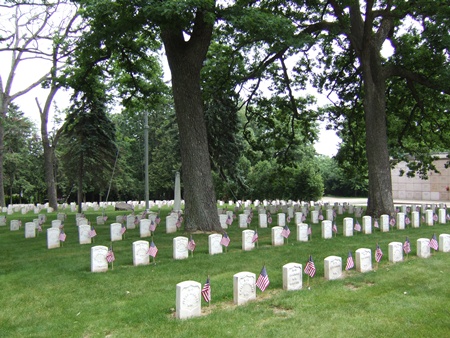
Burials in the soldiers' lot began in 1862. The federal government did not own the soldiers' lot until 1886, when the city of Madison donated the 0.36-acre plot, located in Section 34 of the parent cemetery. Deceased Civil War Union veterans from the local general hospital constitute the majority of the interments. However, there are also Spanish-American War and World War I veterans buried at the site. The last burial was in 1931.
A Confederate plot known as "Confederate Rest" is located approximately 100 yards from this soldiers' lot, but it is not affiliated with the National Cemetery Administration.
Monuments and Memorials
In 1866, Harvey Hospital in Madison was converted into a home for the children of Union soldiers from Wisconsin whose parents were either killed or unable to care for them. For nine years, the Soldiers' Orphans Home cared for the youngsters. Eight of them died between 1866 and 1870 and were buried in Forest Hill Cemetery. Individual headstones are inscribed with the children's initials and a marble obelisk is inscribed with their full name, date of death, and age. The Soldiers' Orphans Monument marble obelisk was dedicated on Decoration Day 1873 and it is one of NCA's oldest memorial objects.
The Woman's Relief Corps, No. 37, erected a large boulder memorial dedicated to the memory of the unknown dead in 1891.
A granite bench inscribed and dedicated to the Grand Army of the Republic is situated at the front of the soldiers' lot.
Under Development.
More than half of VA's national cemeteries originated with the Civil War and many are closed to some burials. Other sites were established to serve World War veterans and they continue to expand. Historic themes related with NCA's cemeteries and soldiers' lots vary, but visitors should understand "Why is it here?" NCA began by installing interpretive signs, or waysides, at more than 100 properties to observe the Civil War Sesquicentennial (2011–2015). Please follow the links below to see the interpretive signs for Forest Hill Soldiers' Lot.
Visit the Veterans Legacy Program and NCA History Program for additional information. Thank you for your interest.


