






National Cemetery Administration
Great Lakes National Cemetery
4200 Belford Rd
Holly, MI 48442
Phone: 248-328-0386
FAX: 248-328-0612
Kiosk: Yes
Follow Us: Facebook
Visitation Hours: Open daily from sunrise to sunset.
Office Hours: Monday thru Friday 8:00 a.m. to 4:30 p.m. Closed federal holidays except Memorial Day.
VA will continue its practice of honoring special requests for weekend burials for religious purposes, in cases of service members killed in action and on at least one day of any three-day Federal holiday weekend at all open VA national cemeteries.
This cemetery has space available to accommodate casketed and in-ground burial of cremated remains. Cremated remains may be placed in the above ground columbarium wall.
Planning ahead for a Veteran's or loved-one's final resting place can eliminate unnecessary delays and reduce stress on a family at a difficult time.
Request eligibility status for:
- Veteran or servicemember
- Spouse
- Dependent family member
Burial in a VA national cemetery is open to all members of the armed forces who have met a minimum active duty service requirement and were discharged under conditions other than dishonorable.
A Veteran's spouse, widow or widower, minor dependent children, and under certain conditions, unmarried adult children with disabilities may also be eligible for burial. Eligible spouses and children may be buried even if they predecease the Veteran.
Members of the reserve components of the armed forces who die while on active duty or who die while on training duty, or were eligible for retired pay, may also be eligible for burial.
From Detroit Metro Airport and points south of Detroit: Take I-94 West to I-275 North, about 18 miles to I-96 West toward Lansing about 18 miles. Take U.S.23 North to Flint. Take Thompson Road Exit 84, turn right on Thompson Road, go to Fenton Road, turn left on Fenton Road, go to Baldwin Road, turn right on Baldwin Road, go to Holly Road, turn right on Holly Road, go to Belford Road, turn left on Belford Road cross the railroad tracks. The cemetery is on the right after crossing the railroad tracks.
From Ann Arbor and points South: Take U.S. 23 North toward Flint. Take Thompson Road Exit 84, and follow the directions from that point above.
From points East of Detroit: Take I-75 N to Holly Road (exit 108). Turn left onto Holly Road then turn left onto Belford Road.
From Lansing and points West: Take I-69 E toward Flint, merge onto I-75 S (exit 133) toward Ann Arbor/Detroit. Take Holly Road (exit 108). Turn right onto Holly Road, turn left onto Belford Road.
From Bishop Airport, Flint: Merge onto I-75 S (exit 133) toward Ann Arbor/Detroit. Stay on I-75 to Detroit. Take Holly Road (exit 108). Turn right onto Holly Road, turn left onto Belford Road.
From Saginaw, Bay City, and points North: Take I-75 S toward Flint and follow the directions from Flint.
Fax all discharge documentation to the National Cemetery Scheduling Office at 1-866-900-6417 and follow-up with a phone call to 1-800-535-1117.
For information on scheduled burials in our national cemeteries, please go to the Daily Burial Schedule.
Any eligible person may be interred at any national cemetery that has available grave space.
Our Memorial Day Ceremony is held at 1:00 p.m. the Sunday before the federal holiday. The Veterans Day Ceremony is held on Veterans Day at 11:00 a.m. Both programs are held at the cemetery assembly area and are sponsored by the Great Lakes National Cemetery Advisory Council.
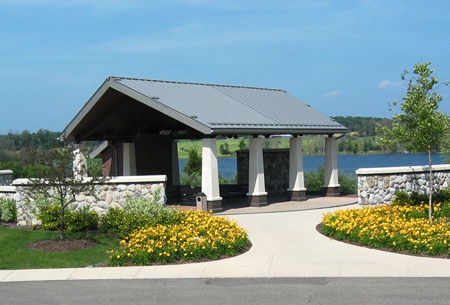
Upon completion of construction Phase 1B on August 1, 2010, Great Lakes National Cemetery has a fully functional Public Information Center, Administration Building, and service and maintenance facility.
Services are held in two committal shelters and services are provided for an average of 11 burials each business day. Phase 1A and 1B provide a total of 4,401 in-ground cremation burial sites, 8,768 columbarium niche sites, 4,650 traditional casket burial sites, and 18,080 double-depth pre-set crypts. Columbarium B has an adjacent committal shelter for services. It is not suited for presentation of military honors.
Funeral honors are provided by the appropriate branch of service when requested by either the funeral director or next-of-kin. The Great Lakes National Cemetery Advisory Council supports volunteer veteran service organization units that provide the rifle volleys in support of the Department of Defense funeral honors team.
Families with special accommodation needs may contact the cemetery staff to see if those needs can be met.
For educational materials and additional information on this cemetery, please visit the Education section, located below.
Fresh cut flowers may be placed on graves at any time. Temporary plastic containers are available.
Artificial flowers may be placed on graves during the period of October 10 through April 15.
Floral items will be removed from graves as soon as they become faded or unsightly.
Plantings and potted plants will not be permitted on graves at any time.
Christmas wreaths or grave blankets are permitted on graves during the Christmas season and will be removed not later than January 20 of each year. Grave floral blankets may not be larger than 2 by 3 feet.
Statues, vigil lights, breakable objects of any nature, and similar commemorative items are not permitted on graves at any time.
Floral items and other types of decorations will not be secured to or laid upon headstones, markers or niche covers.
VA regulations 38 CFR 1.218 prohibit the carrying of firearms (either openly or concealed), explosives or other dangerous or deadly weapons while on VA property, except for official purposes, such as military funeral honors.
Possession of firearms on any property under the charge and control of VA is prohibited. Offenders may be subject to a fine, removal from the premises, or arrest.
Great Lakes National Cemetery is the second national cemetery built in Michigan and the 122nd in the national cemetery system.
Great Lakes National Cemetery is located approximately 50 miles northwest of downtown Detroit, in Holly Township, Oakland County. The cemetery borders Fagan Lake, and is located on a portion of a land grant from the Federal Government to Terrance Fagan in 1836. Historically, the property served as farmland until it was acquired by the National Cemetery Administration in 2002.
In the 20th century, the property was purchased by Bryson Dexter Horton, a Spanish-American War veteran-turned-industrialist who invented the "Square D" switch. Horton's invention dramatically improved electrical safety, by encasing the switch in steel and protecting users from the live electrical current. Mr. Horton constructed a small house on the property in 1927, and reportedly entertained such preeminent locals as Henry and Edsel Ford, who both hunted and fished there.
Great Lakes National Cemetery was established in 2005, and the first burial took place on October 17 of that year.
Medal of Honor
The Medal of Honor is the highest award for valor in action against an enemy force that can be bestowed upon an individual serving in the Armed Services of the United States. Recipients receive the Medal of Honor from the President on behalf of Congress. It was first awarded during the Civil War and the eligibility criteria, medal design, and recognition on a recipients' grave marker have all evolved over time. There are 433 Medal of Honor recipients interred at VA national cemeteries including 6 double recipients.
» Medal of Honor recipients interred or memorialized here:
Corporal Thomas Powers (Indian Wars). Powers (1848–1884) was born in New York City and enlisted in the U.S. Army from Detroit on April 17, 1867. He served during the Indian Wars in Company G, 1st U.S. Cavalry. In October 1869, during the Campaign of the Rocky Mesa, Powers and his fellow troopers were patrolling what would become the state of Arizona in search of the legendary Chiricahua Apache leader Cochise. On October 20th, Powers was involved in a sharp fight with some of Cochise's men who had ambushed a stagecoach. While few details have survived, Powers was credited with killing one warrior and recommended for the Medal of Honor due to his "gallantry in action." His medal was issued February 14, 1870 and he was discharged at Camp Bidwell, California in March 1872. He passed away in December 1884 in Juddville, MI. He was originally interred at Cummin Cemetery but now rests in Section 16, Site 272.
Private First Class Robert Ernest Simanek (Korean War). Simanek was born in Detroit, Michigan and worked in the automobile industry before joining the Marine Corps in August 1951. He sailed for Korea less than a year later and joined Company F, 2nd Battalion, 5th Marines, First Marine Division. On August 17, 1952, during the Battle of Bunker Hill (a prolonged series of battles for frontline outposts), PFC Simanek's unit was ambushed while moving to occupy Outpost Irene and forced to seek cover in a trench line. During the fighting, Simanek threw himself on an enemy grenade to save his comrades and was severely wounded. He was awarded for the Medal of honor for this action. He had previously earned two bronze stars for action in Korea. Simanek returned to the United States and was medically discharged. President Dwight Eisenhower presented him the Medal of Honor on October 27, 1953. He earned a degree in business management after his service. The Department of Navy named an expeditionary sea base in his honor, USS Robert E. Simanek (ESB-7) in 2021. He died on August 1, 2022 and is interred with his wife in Section 35, Site 341.
Other Burials
Private First Class Allan C. Barnes (Vietnam). Barnes (1949–2016) was a jazz saxophonist and Army veteran from Detroit. As a child, he developed a love of music from his uncles, who taught him to play a number of musical instruments, including the saxophone and flute. In 1967, after graduating high school, he enlisted in the U.S. Army and received further musical training from the Naval School of Music. Upon completion of the school, he was deployed to Vietnam as part of the 4th Division Army Band. After receiving an honorable discharge in February 1970, Barnes returned to Detroit where he put together a band named The Blackbyrds. Barnes wrote two of their award-winning songs, "Summer Love" and "Walking in Rhythm," before forming Allan Barnes and Primetime. Throughout his life, he worked with many well-known artists and penned music for a number of television shows and commercials. He also created the show "Jazzland" on PBS. He rests in Section 13, Site 1473.
Sergeant Donald Robert Burgett (World War II.) Burgett (1925–2017) hailed from the west side of Detroit, MI. He enlisted in the U.S. Army at the age of eighteen following the attack on Pearl Harbor. He was assigned to Company A, 1st Battalion, 506th Parachute Infantry Regiment, 101st Airborne Division as a rifleman and machine gunner. Burgett jumped into Normandy on June 5, 1944, and participated in Operation Market Garden, the Battle of the Bulge, and Operation Nordwind, earning three Purple Hearts and a Bronze Star Medal. After the war, Burgett wrote Currahee!: A Screaming Eagle at Normandy (1967) which became a best seller. He went on to write three more popular books about his World War II experiences. The Post Office in Howell, MI was named in his honor. Burgett passed away in 2017 and now rests in Section 12B, Site 614.
Aviation Machinist's Mate Third Class Lynn Everett Chandnois (World War II.) Lynn Chandnois (1923–2011) was born in Fayette, MI. He moved to Flint to attend high school and upon graduation joined the U.S. Navy in 1944. He served two years in the Naval Air Corps during World War II and was discharged in 1946. After his military service, Chandnois attended Michigan State University, where he played football. Chandnois was voted MVP in 1948 and an All-American in 1949. After college he was drafted by the Pittsburgh Steelers, where he played eight seasons until injuries caused him to retire in 1958. Chandnois still holds the Steelers record for returning two kick-offs for touchdowns in 1952. That same year he was voted to the NFL All-Pro team and was the NFL Player of the year. Following his football career, he returned to Michigan to live out the rest of his days. He is now rests in Section CC20, Row A, Site 70.
Steward's Mate First Class Petty Officer Clarence E. Isabell, Jr. (World War II.) Isabell (1926-2015) was born in Memphis, Tennessee. He served in the U.S. Navy during World War II and was honorably discharged in 1946. For three decades, he worked as a barber and also with Motown records as a musician playing the double bass. From 1959 through 1962, he was one of the first members of Motown's Funk Brothers, a group of musicians who backed most of the labels' groups during the 60's and 70's. Isabell was inducted into the Rhythm and Blues Hall of Fame in 2014 and now rests in Section CC11, Row D, Site 42.
Lieutenant Colonel Alexander Jefferson (World War II). Alexander Jefferson (1921–2022) was born in Detroit, MI, and was commissioned a Second Lieutenant in the United States Army Air Forces in January 1944. He joined the 332nd Fighter Group, part of the "Tuskegee Airmen," and flew eighteen missions before he was shot down and captured on August 12, 1944. Jefferson spent eight months as a prisoner of war at Stalag Luft III, and was eventually freed on April 29, 1945. After the war, he became a science teacher with Detroit Public Schools and retired after more than three decades of service. His decorations and awards include the Bronze Star, Air Medal, Purple Heart, and Congressional Gold Medal. LTC Jefferson was also enshrined in the Michigan Aviation Hall of Fame and was portrayed in the miniseries Masters of the Air. He passed away at the age of 100 and is interred in Section CW45, Row A, Site 50.
Flight Officer Russell C. Nalle, Jr. (World War II). Nalle (1921–2025) was born in Detroit, to Russell Sr. and Carol Green Nalle. After graduating high school, he studied at Wayne University and worked for the Ford Motor Company. During World War II, Nalle enlisted in the United States Army Air Forces and joined the Aviation Cadet Corps at Tuskegee Army Air Field for basic flight training. Nalle graduated on September 8, 1944, and became a member of the famed Tuskegee Airmen, an all-Black unit that served in the European Theater of Operations. Nalle later recalled of his wartime service, "I was a young guy, and it was an exciting adventure. I wouldn't have missed that experience for anything." After the war, Nalle worked in real estate and construction. He enjoyed listening to jazz music and watching classic films, and held a life-long fascination with astronomy. He now rests in Section Col-D, Row W58, Site A4.
Lieutenant Colonel Donald Eugene Odell (Korea, Vietnam.) "Digger" Odell (1934–2020) was born in Pontiac, MI. He studied at the University of Oklahoma and the University of Maryland. Digger joined the U.S. Air Force in 1952 and served at several Air Force bases before serving as an F-105 pilot with the 34th Tactical Fighter Squadron in Vietnam. Odell was shot down over North Vietnam in 1967. He was captured and spent nearly six years (1,967 days) in captivity. Odell was placed in the infamous "Hanoi Hilton" where he was isolated and tortured. He was released in 1973 and remained in the Air Force until his retirement in 1975. He chronicled his experiences in the book POW. Odell's decorations include the Silver Star, Legion of Merit, Bronze Star with "V" device and Oak Leaf Cluster, Distinguished Flying Cross with Oak Leaf Cluster, two Purple Hearts, the Air Force Commendation Medal, Vietnam Service Medal with 11 Bronze Battle Stars, and the Prisoner of War Medal. He is interred in Section 15, Site 440.
Private First Class Bonny Rice (Korean War.) "Mack" Rice (1933–2016) was born in Clarksdale, MS. In 1950, when he was 17, his family moved to Detroit where he began writing and performing R&B music. Rice joined his first singing group when still in high school, known as the Five Scalders. After graduation, he was drafted into the Army and was stationed in Germany for two years. While in the service he kept his love for music alive by forming a group called the Bobaliers. Mack worked with both Stax and Motown records throughout his career. He wrote many tunes throughout the years and is best known for his songs "Mustang Sally" and "Respect Yourself." Rice continued to live in the Detroit area. He died at home in Detroit at the age of 82 and is interred in Section 13, Site 1199.
Master Sergeant Guy Stern (World War II.) Dr. Stern (1922–2023) was born Gunther Stern in Germany before moving to the U.S. as a teenager to escape the rising wave of antisemitism. In 1943, Stern was drafted and changed his name to Guy in case of capture. In 1944, he was sent to Camp Ritchie, Maryland to become a member of the celebrated World War II military intelligence unit known as the "Ritchie Boys." After training, he and his team returned to Europe on D-Day as POW interrogators, gaining some highly valuable intelligence for the Allies. For his wartime service, Stern was awarded the Bronze Star Medal and French Medal of Honor. After the war, Stern became a comparative literature scholar and university administrator at Wayne State University and the University of Cincinnati. He also served as the director of the International Institute of the Righteous at the Zekelman Holocaust Center in Farmington Hills, MI. He now rests in Section 17, Site 962.
Lieutenant Colonel Harry T. Stewart, Jr. (World War II). Stewart (1924–2025) was born in Newport News, VA, and grew up in Queens, NY. His fascination with flight took root at an early age, prompting him to join the Junior Birdmen of America, a national organization for children interested in aviation and model plane building. When America became embroiled in World War II, Stewart dropped out of high school to volunteer for aviation cadet training in the U.S. Army Air Forces. By 1944, he was a Second Lieutenant in the famed Tuskegee Airmen. Stewart flew 43 combat missions, and in one dogfight he downed three German aircraft in a single day, earning him the Distinguished Flying Cross. After the war, he obtained a degree in mechanical engineering from New York University and remained in the Air Force Reserve, retiring as a Lieutenant Colonel. Stewart became a passionate advocate for the legacy of the Tuskegee Airmen and had a hand in the group receiving the Congressional Gold Medal in 2007. He passed at the age of 100 and now rests in Section CC10, Row A, Site 30.
We are developing educational content for this national cemetery, and will post new materials as they become available. Visit the Veterans Legacy Program and NCA History Program for additional information. Thank you for your interest.


