






National Cemetery Administration
Fort Meade National Cemetery
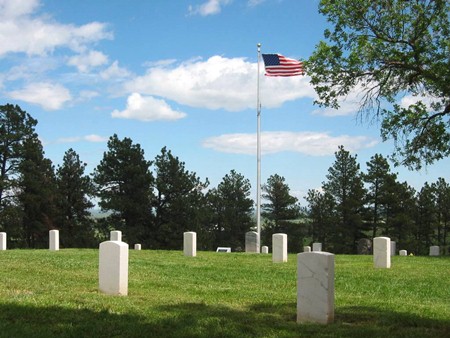
Visitation Hours: April thru October open daily from sunrise to sunset. Closed November thru March.
Office Hours: Contact Black Hills National Cemetery Monday thru Friday 8:00 a.m. to 4:30 p.m. Closed federal holidays.
Fort Meade National Cemetery is closed to new interments. The only interments that are being accepted are subsequent interments for veterans or eligible family members in an existing gravesite. Periodically however, burial space may become available due to a canceled reservation or when a disinterment has been completed. When either of these two scenarios occurs, the gravesite is made available to another eligible veteran on a first-come, first-served basis. Since there is no way to know in advance when a gravesite may become available, please contact the cemetery at the time of need to inquire whether space is available.
Planning ahead for a Veteran's or loved-one's final resting place can eliminate unnecessary delays and reduce stress on a family at a difficult time.
Request eligibility status for:
- Veteran or servicemember
- Spouse
- Dependent family member
Burial in a VA national cemetery is open to all members of the armed forces who have met a minimum active duty service requirement and were discharged under conditions other than dishonorable.
A Veteran's spouse, widow or widower, minor dependent children, and under certain conditions, unmarried adult children with disabilities may also be eligible for burial. Eligible spouses and children may be buried even if they predecease the Veteran.
Members of the reserve components of the armed forces who die while on active duty or who die while on training duty, or were eligible for retired pay, may also be eligible for burial.
From Interstate 90 Exit 34, turn right to the gravel goad, Bureau of Land Management Road, east approximately four miles. Cemetery is on the right. From South Dakota Highway 34/78, one mile east of Sturgis is a gravel road to the cemetery that has a sign stating Fort Meade National Cemetery. This is near the west gate at Fort Meade VA Medical Center. Follow the gravel road approximately 1½ miles. Cemetery is on the left.
Fax all discharge documentation to the National Cemetery Scheduling Office at 1-866-900-6417 and follow-up with a phone call to 1-800-535-1117.
For information on scheduled burials in our national cemeteries, please go to the Daily Burial Schedule.
Fort Meade National Cemetery is managed by Black Hills National Cemetery located at 20901 Pleasant Valley Drive in Sturgis, SD.
The cemetery is located along a gravel road leading from the Fort Meade VA Medical Center and is surrounded by land managed by the Bureau of Land Management. This road is closed during the months of November through March.
For educational materials and additional information on this cemetery, please visit the Education section, located below.
You can place fresh cut flowers on your loved one's grave throughout the year.
Floral items will be removed from graves when they become faded or unsightly. They may also be removed to allow mowing.
You can place artificial flowers on graves from the second Saturday in October through the second Sunday in April, when we do not mow the grounds. Artificial flowers are also allowed the Thursday prior to Easter, Memorial Day, Mother's Day, Father's Day and the Fourth of July. They will be removed the following Sunday after the holidays.
Holiday wreaths less than 18 inches in diameter and no higher than the headstone may be placed on graves beginning on Thanksgiving. Floral grave blankets may not be used. Holiday wreaths will be removed January 15.
To preserve the dignity and appearance of your loved one's final resting place, the following items aren't allowed at headstones or columbariums:
- Alcoholic products
- Balloons, candles, or vigil lights
- Decorative and breakable glass, plastic items, or objects
- Non-government supplied floral containers (pots, planters, glass vase, etc.)
- Objects such as rocks or other durable items, that when mowing or performing maintenance could become projectiles
- Offensive items or those deemed contrary to honoring Veterans
- Permanent in-ground plantings
- Pinwheels or windchimes
- Statues or stuffed animals
- Weapons of any kind, explosives, or ammunition
Please note:
- Floral items or decorations may not be secured to headstones.
- In-ground floral containers may not be placed in new cemeteries or new sections of national cemeteries.
VA regulations 38 CFR 1.218 prohibit the carrying of firearms (either openly or concealed), explosives or other dangerous or deadly weapons while on VA property, except for official purposes, such as military funeral honors.
Possession of firearms on any property under the charge and control of VA is prohibited. Offenders may be subject to a fine, removal from the premises, or arrest.
Fort Meade National Cemetery is located approximately two miles east of the Department of Veterans Affairs Fort Meade Hospital, South Dakota. The Quartermaster Corps established the 2-acre cemetery here on September 24, 1878, and the first interment was made on the same day. The cemetery closed 70 years later after only 188 interments.
Fort Meade was built in 1878 by the surviving troops of General George Armstrong Custer's 7th Cavalry, to keep the peace among the Lakota and Cheyenne tribes and the prospectors. It was named in honor of Major General George G. Meade, whose victory in the Battle of Gettysburg was a turning point in the Civil War. In addition to being the home of the horse Comanche, sole cavalry survivor of the Battle of Little Big Horn, Fort Meade was also the birthplace of the national anthem. In 1892, Colonel Caleb Carton, appalled by the lack of a national anthem, ordered that the "Star-Spangled Banner" be played at the close of all concerts and parades, and later brought this effort to the attention of authorities in Washington, D.C. Subsequently, Secretary of War Daniel E. Lamont issued an order requiring the "Star-Spangled Banner" played at every army post every evening at retreat. In 1914, President Woodrow Wilson signed an executive order making the "Star Spangled Banner" America's national anthem, and in 1931 the bill was signed into law.
Fort Meade National Cemetery contains both government-furnished headstones and private monuments installed by family or friends. As a result, there are a number of distinctive gravesites, including some enclosed by wooden boards and ornamental pipe fencing. The diversity of the graves reflects the array of those laid to rest at Fort Meade. Enclosed by a wrought-iron fence, for example, is the gravesite of Otto Von Wargowski, only 30 when he died and apparently a member of the Prussian nobility. Not far away are two side-by-side graves marked as "Child of Civilian Refugee" and "Lucy, Child, Sioux Indian."
Fort Meade National Cemetery was placed on the National Register of Historic Places on May 22, 1973.
Monuments and Memorials
An obelisk monument honors the memory of two soldiers from the 7th cavalry who, according to legend, died as a result of drinking wood alcohol while on patrol.
Bivouac of the Dead erected 2004.
Medal of Honor
The Medal of Honor is the highest award for valor in action against an enemy force that can be bestowed upon an individual serving in the Armed Services of the United States. Recipients receive the Medal of Honor from the President on behalf of Congress. It was first awarded during the Civil War and the eligibility criteria, medal design, and recognition on a recipients' grave marker have all evolved over time. There are 433 Medal of Honor recipients interred at VA national cemeteries including 6 double recipients.
» Medal of Honor recipients interred or memorialized here:
Private Abram B. Brant (Indian Wars). He received the Medal of Honor while serving in the U.S. Army, Company D, 7th U.S. Cavalry, for actions at the Little Big Horn River, Montana Territory, June 25, 1876. Brant died in 1878 and is memorialized in Section 2, Row 4, Site 187.
Sergeant Albert Knaak (Indian Wars). He received the Medal of Honor while serving in the U.S. Army, Company B, 8th U.S. Cavalry, for actions in the Arizona Territory, from August to October 1868. Knaak died in 1897 and is buried in Section 2, Row 1, Site 101.
Other Burials
There are several Buffalo Soldier burials.
We are developing educational content for this national cemetery, and will post new materials as they become available. Visit the Veterans Legacy Program and NCA History Program for additional information. Thank you for your interest.


