






Mount Moriah Cemetery Soldiers' Lot
Office Hours: Monday thru Friday 8:00 a.m. to 4:30 p.m.
Closed federal holidays except Memorial Day and Veterans Day.
Visitation Hours: Open daily from sunrise to sunset.
This soldiers' lot is closed to interments.
Planning ahead for a Veteran's or loved-one's final resting place can eliminate unnecessary delays and reduce stress on a family at a difficult time.
Request eligibility status for:
- Veteran or servicemember
- Spouse
- Dependent family member
Burial in a VA national cemetery is open to all members of the armed forces who have met a minimum active duty service requirement and were discharged under conditions other than dishonorable.
A Veteran's spouse, widow or widower, minor dependent children, and under certain conditions, unmarried adult children with disabilities may also be eligible for burial. Eligible spouses and children may be buried even if they predecease the Veteran.
Members of the reserve components of the armed forces who die while on active duty or who die while on training duty, or were eligible for retired pay, may also be eligible for burial.
From Philadelphia International Airport take 95 North to Island Avenue West, this changes to Cobbs Creek Parkway. Rear entrance of cemetery is off Cobbs Creek Parkway. Follow cemetery road to the left to Soldiers Plot.
Fax all discharge documentation to the National Cemetery Scheduling Office at 1-866-900-6417 and follow-up with a phone call to 1-800-535-1117.
For information on scheduled burials in our national cemeteries, please go to the Daily Burial Schedule.
The private and community cemeteries that contain NCA soldiers' and government lots, and Confederate cemeteries, do not always have staffed offices on site. When administrative information for the larger cemetery is available, it is provided below.
This soldiers' lot is overseen by the Washington Crossing National Cemetery.
Please contact the national cemetery for more information.
For educational materials and additional information on this cemetery, please visit the Education section, located below.
Our cemetery floral and grounds policies exist only to reflect the honor and respect we hold for our Nation's Veterans, by preserving the dignity and solemnity of their final resting place.
We welcome and encourage fresh-cut flowers throughout the year. Temporary floral containers are located throughout the cemetery for public use. Floral arrangements will be removed when they become withered, faded, or unsightly. During the mowing season, floral arrangements shall be removed weekly to facilitate mowing operations. Floral arrangements shall not stand taller than the headstone.
Artificial flowers will be permitted from November 1 – April 1.
Permanent plantings, statues, vigil lights, breakable objects, and similar items are not permitted at the graves. This includes, but is not limited to hazardous materials, glass, metal, toys, candles, balloons, wind chimes, and pinwheels. Flags are not permitted at the graves.
No permanent floral vases are permitted.Potted plants will be permitted on graves one week before and one week after Easter Sunday and Memorial Day.
Holiday wreaths and grave blankets are permitted on graves from December 1 through January 10 and will be removed after January 20 of each year. Grave blankets shall be no larger than 2 x 3 feet.
The Department of Veterans Affairs does not permit adornments which might be considered offensive, inconsistent with the dignity of the cemetery, or considered hazardous to cemetery personnel. For example, items incorporating beads or wires which may become entangled in mowers or other equipment and cause injury. Unauthorized items will be removed immediately. Floral arrangements and other decorations may not be secured to the headstone.
VA regulations 38 CFR 1.218 prohibit the carrying of firearms (either openly or concealed), explosives or other dangerous or deadly weapons while on VA property, except for official purposes, such as military funeral honors.
Possession of firearms on any property under the charge and control of VA is prohibited. Offenders may be subject to a fine, removal from the premises, or arrest.
Mount Moriah Cemetery was established by the Pennsylvania Legislature in 1855, one of several rural cemeteries developed in Philadelphia between 1845 and 1860. Located on the southwestern edge of the city, the private cemetery originally consisted of 54 acres. Over time it has grown to 380 acres spanning both sides of Cobbs Creek. Due to the massive size of the cemetery, many churches and other organizations have established smaller lots within its bounds. A majestic gatehouse provides entrance into to the cemetery. Designed by local architect Stephen D. Button in 1855, the Romanesque gatehouse is fabricated from brownstone.
Notable headstones in the cemetery include a granite marker constructed in the shape of the Civil War iron-clad ship, the USS Monitor. The headstone memorializes William Rowland, a sailor on the USS Minnesota, which was protected by the Monitor from the CSS Virginia (formerly the USS Merrimack) at the Battle of Hampton Roads.
For a time Mount Moriah Cemetery held the remains of Betsy Ross, reputed maker of the American flag. However, leading up to the local celebration of the 1976 Bicentennial, her remains were moved to Arch Street near the Betsy Ross house.
In the early 1870's, an African-American named Henry Jones purchased a lot in the cemetery. After his death, cemetery authorities turned away his funeral procession at the gate, on the basis of his race. A lawsuit was filed against the Mount Moriah Cemetery association on his behalf, and in 1876 the Supreme Court ruled in favor of Jones' right to burial in the cemetery.
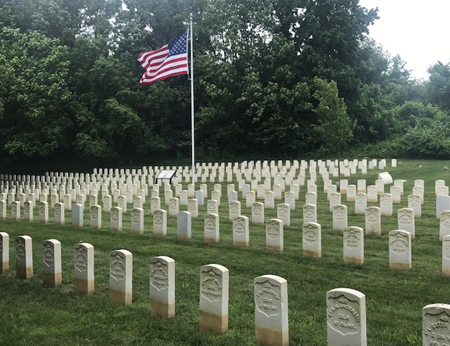
Mount Moriah Cemetery Soldiers' Lot is located in section 200, lot 1, of Mount Moriah Cemetery, and is sometimes referred to as the Civil War Hospital Plot. The 404 soldiers buried in this lot died in Philadelphia hospitals from injuries or disease during the Civil War. Initially, the soldiers' lot included the remains of many Confederate soldiers, but in 1885 all but two were exhumed and re-interred at Philadelphia National Cemetery. In 1906 the Office of the Quartermaster General halted re-interments between the two cemeteries.
The National Cemetery Administration has jurisdiction over this section of the cemetery and the Naval Plot.
Under Development.
More than half of VA's national cemeteries originated with the Civil War and many are closed to some burials. Other sites were established to serve World War veterans and they continue to expand. Historic themes related with NCA's cemeteries and soldiers' lots vary, but visitors should understand "Why is it here?" NCA began by installing interpretive signs, or waysides, at more than 100 properties to observe the Civil War Sesquicentennial (2011–2015). Please follow the links below to see the interpretive signs for Mount Moriah Soldiers' Lot.
Visit the Veterans Legacy Program and NCA History Program for additional information. Thank you for your interest.


